
The Tax Savings You Don’t See: Tax Planning for Business Owners in 2026

Preface: “Planning is bringing the future into the present so that you can do something about it now.” — Alan Lakein, time-management author

The Tax Savings You Don’t See: Tax Planning for Business Owners in 2026

Diligent business owners don’t wait until April to think about taxes.  Imagine two business owners operating nearly identical companies. Both generate $1.5 million in annual revenue, earn $300,000 in profits, and work equally hard to build successful businesses. Yet when tax season arrives, one discovers a surprisingly large tax bill while the other has already anticipated the liability, made strategic investments, and positioned the business for future growth.

What made the difference? It wasn’t necessarily a better accountant, a more sophisticated business structure, or a secret deduction buried somewhere in the Internal Revenue Code. More likely, it was something remarkably simple: one business owner planned ahead while the other waited to see what happened.

As we approach the end of 2026, business owners have an important opportunity to evaluate their financial performance, understand recent tax law changes, and make decisions that could meaningfully influence their tax liabilities. The challenge is recognizing that effective tax planning is about much more than minimizing this year’s taxes. It’s about keeping more of what you earn, improving cash flow, and building a financially stronger business.

  1. Know Your Numbers Before the Year Ends

One of the most common mistakes business owners make is assuming that their bank balance tells them how profitable their business has been. Unfortunately, cash in the bank and taxable income are two very different things.

A company might have $200,000 in its checking account but owe taxes on $400,000 of taxable income. Another might have limited available cash despite reporting substantial profits.

Before December 31, review your year-to-date financial statements and prepare a reasonable projection of your full-year taxable income. Include anticipated revenues, expenses, depreciation, owner compensation, and other significant transactions.

The objective is to answer three questions: How much taxable income are we expecting? What will our tax liability likely be? And what opportunities remain to improve the outcome?

A business owner who knows these answers in November has options. A business owner who discovers them in March mostly has paperwork.

  1. Understand the New Opportunities for Equipment and Capital Investments

The federal tax rules for business investment have changed significantly, creating valuable opportunities for companies planning equipment purchases, facility improvements, or expansion.

Under the 2025 tax legislation commonly known as the One Big Beautiful Bill Act, 100% bonus depreciation was restored for qualifying property acquired and placed in service after January 19, 2025. This means many qualifying equipment purchases made during 2026 may be eligible for an immediate federal deduction rather than depreciation spread over several years. Additionally, the Section 179 deduction limit for 2026 is $2.56 million, subject to qualifying purchase limits and taxable-income restrictions.

Consider a manufacturer planning to purchase a $150,000 machine early next year. If the equipment is genuinely needed, purchasing and placing it in service before year-end could create a substantial 2026 deduction.

But here’s an important distinction: Spending $150,000 to save $45,000 in taxes still means spending $105,000 after the tax savings. A tax deduction should improve a sound business decision, not justify an unnecessary purchase. The smartest approach is to coordinate capital investments with operational needs, cash flow, financing, and the company’s broader financial strategy.

  1. Don’t Overlook the Qualified Business Income Deduction

For many owners of partnerships, S corporations, and sole proprietorships, the Qualified Business Income deduction under Section 199A remains one of the most valuable provisions in the tax code. The deduction generally allows eligible business owners to deduct up to 20% of qualified business income, subject to limitations based on taxable income, wages, business assets, and the type of business.

The 2025 tax legislation made this deduction permanent, removing the previously scheduled expiration after 2025. For 2026, the taxable-income thresholds at which certain limitations begin are $403,500 for married couples filing jointly and $201,750 for other filers. This creates opportunities to evaluate retirement contributions, owner compensation, income timing, and other planning decisions.

A particularly important consideration for S corporation owners is reasonable compensation. Paying yourself too little can create payroll tax compliance concerns, while excessive compensation may unnecessarily reduce qualified business income eligible for the deduction. The objective is not simply to maximize deductions. It is to establish a defensible compensation strategy that supports both tax efficiency and compliance.

  1. Make Retirement Planning Part of Your Tax Strategy

Retirement contributions are sometimes overlooked because business owners are focused on reinvesting profits into their companies. However, retirement plans can accomplish two objectives simultaneously: reducing current taxable income and helping owners build wealth outside their businesses. Depending on the company’s size, employee demographics, and existing benefits, options may include SEP IRAs, SIMPLE IRAs, 401(k) plans, and cash balance pension plans.

For 2026, the basic employee elective deferral limit for a 401(k) is $24,500, with additional catch-up opportunities for eligible participants. For a profitable business owner approaching retirement, a properly designed retirement plan may offer significant tax benefits while also providing an attractive employee benefit. The key is evaluating plan design before applicable deadlines. Some strategies require decisions or employee communications well before the tax return is prepared. A successful retirement strategy should consider both the business owner’s personal financial objectives and the company’s responsibilities to its employees.

  1. Pay Attention to State Taxes and Pass-Through Entity Elections

Federal taxes often receive the most attention, but state taxes can create equally important planning opportunities. For eligible Pennsylvania pass-through businesses, an especially important consideration is whether elections in other states could reduce the overall tax burden. Certain states permit pass-through entities to pay income taxes at the business level, potentially creating a federal deduction that would otherwise be limited at the individual level. These pass-through entity tax elections can be particularly relevant for businesses operating in multiple states.

However, the rules vary considerably by jurisdiction. Election deadlines, estimated payments, resident credits, and ownership structures all influence whether a particular election is beneficial. Business owners should also review state nexus, sales tax exposure, and withholding obligations when expanding operations or selling into new markets. A company can be financially successful in a new state and still discover that it overlooked important compliance obligations.

  1. Review Your Business Structure and Owner Compensation

As companies grow, their original business structure may no longer provide the best combination of tax efficiency, liability protection, and administrative simplicity. A business that began as a sole proprietorship might benefit from evaluating S corporation taxation. An established S corporation might need to reconsider compensation, distributions, shareholder basis, or succession planning. But changing entities should never be viewed as an automatic tax-saving strategy.

Entity conversions can create unexpected tax consequences, additional administrative costs, and complications involving appreciated assets or existing liabilities. A thoughtful review should consider projected profitability, ownership plans, compensation requirements, and long-term objectives. The right structure is not necessarily the one producing the lowest tax bill this year. It’s the one that supports the company’s financial future.

  1. Think Beyond December 31: Tax Planning Is a Wealth-Building Strategy

Perhaps the most valuable tax-planning lesson is that minimizing taxes and maximizing wealth are not always the same thing. Imagine a business owner who can defer $100,000 of taxable income into next year. At first glance, that sounds attractive. But what happens if next year’s tax rate is higher, the business owner sells the company, or significant additional income is expected?

Sometimes accelerating income into the current year produces a better long-term result. Similarly, maximizing depreciation today may reduce deductions available in future years or create additional taxable income when an asset is sold. Effective tax planning considers multiple years, not just the next tax return. For business owners contemplating succession, expansion, real estate investments, or eventual retirement, this broader perspective becomes especially important.

The Bottom Line: Don’t Let the Calendar Make Your Decisions

There is an old business principle worth remembering: What gets measured gets managed. Tax planning works much the same way. Business owners who regularly review financial results, understand their tax exposure, and discuss opportunities with their advisors are better positioned to make informed decisions. Those who wait until their tax returns are prepared often discover that the most valuable opportunities have already passed.

With year-end approaching, now is the time to review your tax position and identify opportunities that may disappear after December 31. A conversation with your CPA before the year closes can help you make informed decisions that support both your immediate tax objectives and your long-term financial goals.
Social Security – The Unraveling

Preface: “It will be a great day when our schools have all the money they need, and our air force has to have a bake sale to buy a bomber.” — Robert Fulghum

Social Security – The Unraveling

The following is the seventh in a series of blog posts on the subject of Social Security. The first six installments, which can be found here, here, here, here, here, and here:

      • Reviewed the history of the Social Security program
      • Explained how to claim Social Security retirement benefits
      • Explained how to claim Social Security survivor and family member benefits
      • Explained how Social Security benefits are taxed
      • Explained how earned income is taxed to fund Social Security
      • Addressed the regressive nature of FICA

This seventh installment will discuss:

      • Residual structural problems with Social Security

Future posts in this series will address:

      • Estimating Social Security’s returns on investment

The Contradictions Inherent in the System

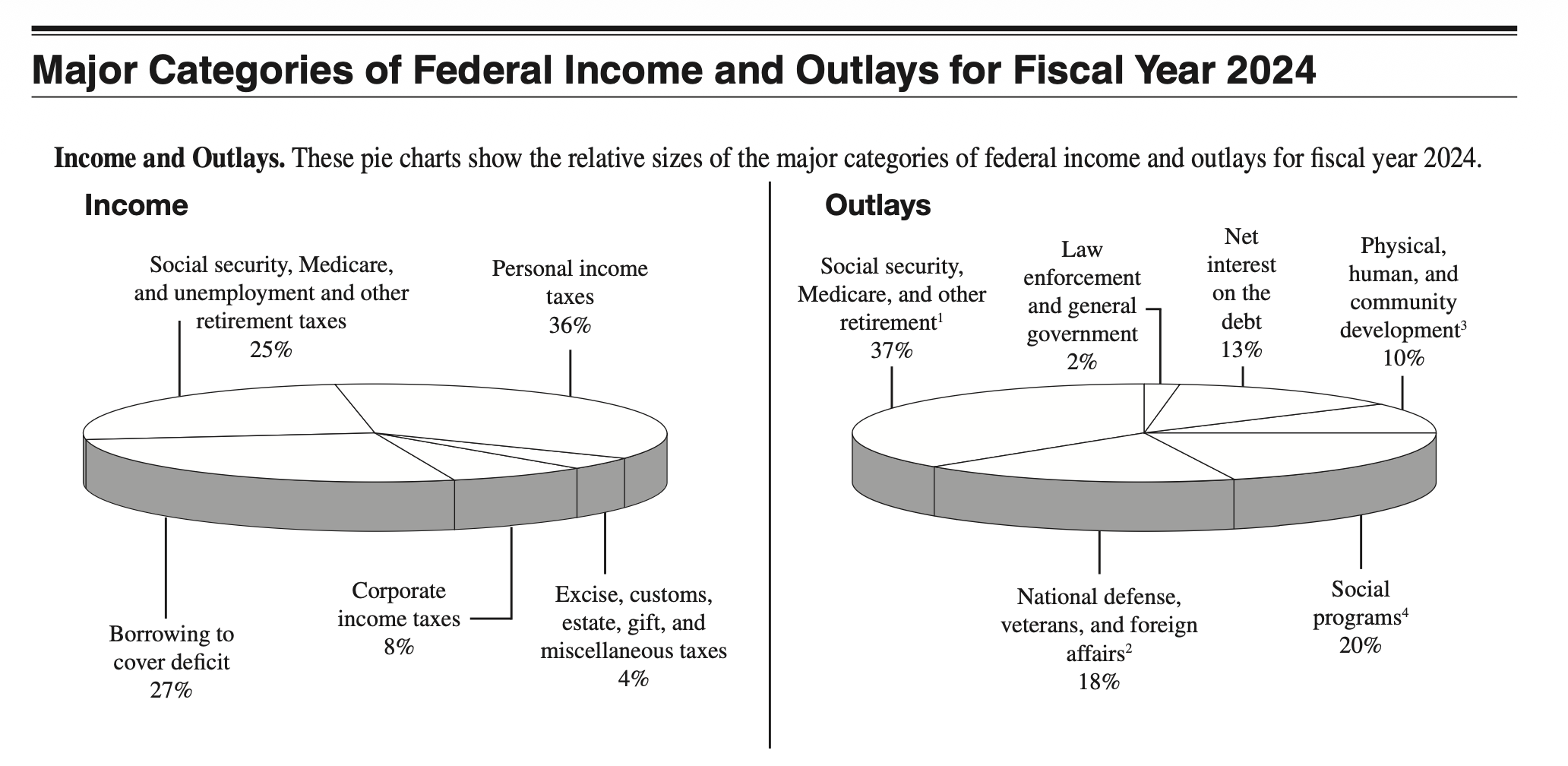
Don’t look at the above pie charts published in the instructions to IRS Form 1040 for tax year 2025 before you have answered the following two questions:

      • What percentage of the federal budget of the United States do you think is spent on national defense, including veterans and foreign affairs?
      • What percentage of the federal budget do you think is spent on Social Security Medicare, and other retirement?

Now, take a look at the “Outlays” chart on the right. Do the results surprise you? Consider also that the 37% spent on Social Security, Medicare, and other retirement doesn’t even include the 20% spent on other social programs (like SNAP and other forms of temporary assistance). Nor does it include the 10% spent on “Physical, human and community development” (like farm aid, environmental spending, and aid to college students). The total for those three categories is 67% of every federal dollar spent. That is almost four times the amount spent on national defense (including all veteran benefits and all foreign aid).

Now, look at the pie chart on the left, the one that says “Income”. You will notice that the segment for Social Security, Medicare, and other retirement is only 25% of income, even though it is 37% of outlays. While the details are always more complicated than a simple breakdown like this, a discrepancy this large between income and outlays surely constitutes a long-term funding problem.

The Social Security Trust Funds

While regular income tax goes into the General Treasury Account to be divided up by legislators and fought over by government agencies, FICA is deposited in two Social Security Trust Funds, one for Social Security benefits and one for Medicare. Looked at a certain way, this makes Social Security and Medicare “safe” in the sense that funds raised for these purposes cannot be spent on other things on a political whim.

But it does not guarantee that the funds will be there. Nor does it guarantee that the FICA you pay in is held for you so that it is there when you retire. The trust funds are held in trust for the programs, not in trust for the individual participant. The funds are pay-as-you-go. What is being deducted from your paycheck now is paying benefits to those claiming them now. The benefits you will claim when you retire will be paid out of the paychecks of those still in the workforce at that time. Looked at this way, Social Security resembles a Ponzi scheme.

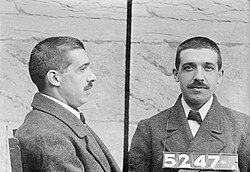
A Ponzi scheme is an investment that pays current investors with funds obtained from newer investors. As long as each cohort of new investors is larger than previous ones, new premiums are sufficient to provide a profit to the existing investors. When sufficiently large numbers of new investors can no longer be found, the scheme unravels and the later investors are left with nothing. The scheme is named after Charles Ponzi who perpetrated one of the largest known operations of this type in the 1920s. But it was eclipsed in size and scope by Social Security a decade later.

One lucky break Social Security had was that within a decade of its creation and before many people had filed to claim benefits, the largest generation in American history was born, the so-called “boomer” generation. This created optimal Ponzi conditions that masked the program’s fatal flaws for the better part of a century. Another lucky break was that the U.S. economy was growing rapidly in the 1950s and 1960s. This meant that larger numbers of younger workers were paying in larger amounts a to fund a smaller cohort of retirees who had paid in smaller amounts back in the 1930s and 1940s.

Social Security had been very controversial when it was first signed into law in 1935. But after an entire generation had grown up with it, it began to seem normal. It appeared solvent and any misgivings anyone had voiced about it seemed misplaced. The elderly and disabled retired in dignity, widows and orphans were protected, and workers hardly noticed paying a few percent of their wages into it. This seemed like such a winning formula that it was used as a model for Medicare when that program was signed into law 30 years later.

The system began to unravel in the 1970s. Medicare put additional strain on FICA funding sources. Even worse, birth rates had been falling and the recession of the 1970s, the first major economic setback in America in 40 years, brought things to a head as jobs disappeared and pension plans became insolvent. Now a larger cohort entitled to larger benefits was beginning to retire and the new cohort of younger workers was too small and didn’t earn enough to fund them. This is analogous to the part of Charles Ponzi’s career where he goes to jail.

Inevitably, FICA rates and caps had to be raised and additional taxes had to be implemented to cover the shortfall. As discussed in an earlier post in this series, Social Security retirement benefits were not themselves subject to taxation until 1983. Social Security has lurched from crisis to short-term fix ever since, with bankruptcy always just around the corner, millions of indigent Americans on the chopping block, and ensuing political hysteria. As the last of the boomer generation retires and birthrates continue to fall, we can expect these cycles to become more rapid and more severe.

Stop the Cap

When FICA was first introduced in 1935, it applied at a rate of 2% to earned income up to $3,000. As the Social Security program is continually running out of money, both the FICA rate and the “cap” on income it applies to have been periodically increased. As of 2026, the rate is 15.3% and the cap is $184,500. And the program is still running out of money.

One key problem is that Social Security insists on paying benefits to high earners. Not only that, but it pays larger benefits to high earners than to low earners. This is not what anyone wants or expects Social Security to do. There would be political hell to pay if Social Security benefits were ever cut for low earners, but changes to caps or benefits to high earners would be politically feasible. It would also save a ton of money.

The reason the large benefits are still paid to the high earners is to maintain the fiction that Social Security is insurance or some kind of investment program. This is a very expensive fiction.

Raising the cap is a particularly cynical and pernicious fix. In the short run, the higher cap raises more income to fund the benefits paid to current recipients. But those paying more now will later claim larger benefits based on those larger payments they made.

Two good changes did emerge from the insolvency turmoil of the 1970s. One was the Employee Retirement Income Security Act of 1974 (ERISA) that began shifting the burden of retirement funding from employers to employees. Fifty years later, we must acknowledge that ERISA has been the success that Social Security wasn’t. IRAs and 401(k)s really do allow working people to retire in dignity. What’s more, they do it without fomenting national crises every few years. In fact, ERISA has probably made Social Security redundant, at least for mid to high earners.

The other good thing was Supplemental Social Security (SSI) in 1972. This is Social Security for people who have not paid enough in FICA to be eligible for benefits under Social Security. These are really the people Social Security was designed for and the people we think of when we think of Social Security. But these are not the people who receive most of the benefits under the current system.

What SSI did is to decouple at least some Social Security payments from FICA. This took some of the pressure off FICA. But more importantly, it set the precedent that at least some Social Security benefits could be paid out of general U.S. Treasury funds. These are the same general funds that fund other government programs. There is no pretense that SSI is a form of insurance or that it pays for itself. And that’s OK. The armed forces don’t pay for themselves, either. In a way, SSI makes FICA redundant, we just won’t admit it yet.

Porter’s Five Forces: The Hidden Forces That Determine Business Success

Preface: “The essence of formulating competitive strategy is relating a company to its environment.” — Michael E. Porter, Competitive Strategy: Techniques for Analyzing Industries and Competitors (1980)

Porter’s Five Forces: The Hidden Forces That Determine Business Success

Why do some businesses consistently earn excellent profits while others struggle, even when both have hardworking owners, talented employees, and satisfied customers? Michael Porter, one of the world’s most influential business strategists, argues that the answer often lies beyond the business itself. In his landmark book Competitive Strategy, Porter explains that profitability depends not only on how effectively a company operates but also on the competitive forces shaping its industry. His Five Forces framework gives business leaders a practical way to understand these pressures, strengthen their competitive position, and build businesses that can sustain attractive profits over time.

The first force is competitive rivalry. When many businesses offer similar products or services, competition often centers on price. This is particularly challenging in industries with high fixed costs, slow growth, or limited differentiation. Consider a manufacturer generating $5 million in revenue with a 10% operating margin. A 5% reduction in selling prices, assuming unchanged volume and costs, could reduce operating profits from $500,000 to $250,000. That is a 50% decline in profitability from a seemingly modest price concession. Porter teaches that businesses should avoid competing exclusively on price. Instead, they should develop meaningful differences through quality, reliability, specialized expertise, customer relationships, or superior service. The more interchangeable customers perceive competing businesses to be, the more difficult it becomes to maintain healthy margins.

The second force is the threat of new entrants. Profitable industries naturally attract entrepreneurs and investors seeking similar opportunities. Unless barriers discourage entry, new competitors increase supply and eventually pressure prices and profits. Barriers to entry include substantial capital requirements, economies of scale, specialized expertise, customer loyalty, switching costs, established distribution networks, and regulatory requirements. For example, opening a small accounting practice may require relatively modest capital, but developing a respected advisory firm with experienced professionals, sophisticated expertise, and trusted client relationships takes years. Porter reminds us that a genuine competitive advantage is not simply something a company does well; it is something competitors cannot easily replicate.

The third force is supplier bargaining power. Suppliers influence profitability by controlling the cost, quality, and availability of essential resources. When few suppliers offer a critical product, they can often demand higher prices or less favorable terms. This principle extends beyond raw materials to skilled employees. For professional service firms, experienced accountants and advisors represent essential resources. When qualified talent becomes scarce, compensation pressures increase, and profitability can decline. Businesses can strengthen their position by diversifying suppliers, developing internal talent, improving processes, and reducing dependence on individual resources. Strong employee development and retention programs are therefore not merely human resource initiatives; they can become meaningful strategic advantages.

The fourth force is buyer bargaining power. Customers possess greater negotiating leverage when they can easily switch suppliers, compare prices, purchase substantial volumes, or represent a significant percentage of a company’s revenue. Imagine a manufacturer with $8 million in annual sales whose largest customer accounts for $3 million. That customer may demand pricing concessions because the manufacturer cannot easily afford to lose the relationship. Customer concentration therefore creates both financial risk and reduced pricing flexibility. Businesses can protect themselves through customer diversification and differentiation. When customers recognize the economic value of exceptional service, reliability, expertise, or problem-solving, they become less likely to select providers solely on price.

The fifth force is the threat of substitutes. Perhaps the most overlooked competitive danger comes from businesses offering entirely different solutions to the same customer problem. A restaurant competes not only with other restaurants but also with home cooking. An equipment dealership may compete with rental services. Accounting firms increasingly face competition from alternative solutions, including automation, artificial intelligence, and self-service financial software.
Porter encourages leaders to define their businesses around the problems customers need solved rather than the products or services currently being sold. Understanding substitutes helps businesses anticipate changing customer expectations and develop services that remain relevant as technology and markets evolve.

The real power of Porter’s framework comes from understanding how these forces interact. A company may operate efficiently yet struggle because powerful customers, aggressive competitors, and readily available substitutes continually compress its margins. Another company may enjoy stronger profitability because it possesses specialized capabilities, loyal customers, and meaningful barriers to entry. Industry structure is not destiny, however. Superior leadership, innovation, culture, and operational excellence can help companies outperform competitors facing similar conditions. Porter also distinguishes operational effectiveness from strategy: performing existing activities better is valuable, but strategy requires choosing a distinctive position that creates sustainable economic value.

These principles have important implications for business valuation and succession planning. Two companies may each generate $1 million in annual EBITDA, yet command substantially different valuations. A company with concentrated customers, weak pricing power, and easily replicated services may deserve a lower valuation multiple than one with diversified customers, specialized capabilities, and dependable recurring earnings. Business value depends not simply on current profitability but also on the sustainability and risk of future earnings. Strengthening competitive advantages can therefore increase both operating performance and enterprise value.

For business leaders, Porter’s framework encourages several essential questions: Where do we face the greatest competitive pressure? What makes our business meaningfully different? How dependent are we on major customers, suppliers, or key employees? Which technologies or substitutes could change our industry? And perhaps most importantly, are our investments strengthening our competitive position or simply helping us keep pace with competitors?

The greatest lesson from Porter is that growth and success are not necessarily the same thing. Increasing revenue, adding employees, purchasing equipment, and expanding facilities may create a larger organization without creating a stronger business. Sustainable success requires thoughtful choices about customers, markets, services, pricing, talent, and capital investment. Great businesses are built not merely by working harder than competitors but by understanding the economics of competition and creating clear value propositions that others cannot easily reproduce.

Ultimately, Porter’s Five Forces challenges entrepreneurs to move beyond asking, “How can we grow our business?” and begin asking a more powerful question: “How can we build a business that is more profitable, more resilient, more valuable, and better positioned to flourish for generations?”