Social Security – Claiming Family Member and Survivor Benefits

Preface: “We can never insure one hundred percent of the population against one hundred percent of the hazards and vicissitudes of life, but we have tried to frame a law which will give some measure of protection to the average citizen and to his family against the loss of a job and against poverty-ridden old age.” –– Franklin D. Roosevelt, Statement on Signing the Social Security Act

Social Security – Claiming Family Member and Survivor Benefits

The following is the third in a series of blog posts on the subject of Social Security. The first two installments, which can be found here and here:

      • Reviewed the history of the Social Security program
      • Listed the different types of Social Security benefits
      • Explained how to claim Social Security retirement benefits

This third installment will discuss:

      • Claiming family member benefits
      • Claiming survivor benefits

Future posts in this series will address:

      • How earned income is taxed to fund Social Security
      • How Social Security benefits are taxed
      • Estimating Social Security’s return on investment

Social Security is known as a sort of a pension plan, as the retirement benefits do provide partial income replacement for retirees. But Social Security boasts a generous number of other types of benefits. Survivor benefits function as a sort of a life insurance for the benefit of dependents whose providers have passed away. And family member benefits, in particular spousal benefits, provide supplemental income to family members of living retirees.

Family Member Benefits

Family members of people who are receiving Social Security retirement benefits can, if certain conditions are met, receive their own benefits that are computed as a percentage of the benefit received by the recipient of the retirement benefit. Before we delve into the details of which family members are eligible and what percentage they receive, it is important to understand that family member benefits do not come at the expense of the retirement benefits.

EXAMPLE:

I am retired and eligible to receive a $2,000 per month Social Security retirement benefit. My wife is entitled to a spousal benefit worth 50% of mine. She will receive $1,000 per month in addition to my $2,000 per month. Her benefit will not be deducted out of my benefit.

And so for all family member benefits (but see The Family Maximum at the end of this article).

Another important principle of family member benefits is that anyone who is eligible for his or her own retirement benefit cannot claim both that retirement benefit and a family member benefit. Generally, you will choose the benefit that is larger.

EXAMPLE:

I am retired and eligible to receive a $2,000 per month Social Security retirement benefit. My wife is entitled to a spousal benefit worth 50% of mine. However, she is also entitled to a retirement benefit in her own right.

If her retirement benefit is larger than $1,000, she is better off taking that and foregoing the family member benefit.

If her retirement benefit is larger than $4,000, then I am better off foregoing my own retirement benefit as I can instead claim a family member benefit worth 50% of hers.

Both spouses and dependent children may receive family member benefits. Neither type of benefit can be more than 50% of the value of the retirement benefit. For this purpose, the base amount is the retirement benefit as claimed by the retired individual at full retirement age (FRA). Current law defines (FRA) for people born in 1960 and after as 67. As covered in a previous blog post, a retiree can claim a larger amount by waiting until past FRA to claim. However, family member benefits are in any case based on the FRA benefit.

A spouse must be 62 years or older to receive the family member benefit, or any age if taking care of a child who is younger than age 16 or has a qualifying disability.

The percentage value of a spousal benefit depends on the spouse’s own age when claiming the benefit. At full retirement age (FRA), the spouse can claim the maximum 50%. For each year before FRA, the percentage is reduced slightly, down to a minimum of 32.5% if claiming at age 62.

A dependent child must be younger than 18 to receive the family member benefit, or younger than 20 if a full-time student, or any age if having a disability that began before age 22.

Dependent child benefits are generally not less than 50% of the retirement benefit. But see The Family Maximum at the end of this article

Employing a Spouse as a Social Security Strategy

There is no legal impediment to employing your spouse. A spouse-employee should be paid a wage comparable to what you would pay a non-related employee for doing the same work. If you decide to do this, you should understand that you are making your spouse an employee who must be paid for work that is actually performed, the same as any other employee. You cannot just pay part of your salary to your spouse and then expect that your spouse can claim Social Security credit on it. If you both perform work for the business, you must each receive a salary based on your respective roles. As your spouse’s employer, you will be paying the employer share of Social Security and Medicare taxes (FICA) based on your spouse’s wages. The only special dispensation you have as a spouse-employer is that you do not have to pay FUTA (federal unemployment) taxes on a spouse’s wages.

If the only reason for employing your spouse is to build eligibility for future Social Security benefits, consider that a spouse is in any case entitled to family member benefits when you retire based on your earnings.

Survivor Benefits

Three types of dependents may qualify for Social Security survivor benefits based on a deceased family member’s Social Security retirement benefits:

      • Spouses and ex-spouses who were married to the deceased at least 9 months, have not remarried, and are age 60 or older (age 50 or older if with a disability)
      • Children age 17 and younger, or aged 18-19 and in K-12 education, or any age if with a disability acquired at age 21 or younger
      • Dependent parents age 62 or older who have not remarried and who are not receiving Social Security benefits in their own right that would be greater than the survivor benefit.

Survivor benefits are paid as a percentage of the benefits that would have been paid to the deceased at full retirement age (FRA).

Children receive payments at 75%.

The value of a payments for a spouse or ex-spouse depends on the spouse’s or ex-spouse’s own age when claiming the benefit. At full retirement age (FRA), the spouse or ex-spouse can claim 100%. For each year before FRA, the percentage is reduced slightly, down to a minimum of 71.5% if claiming at age 60.

A lone dependent parent receives 82.5% percent and two dependent parents receive 75% each.

Lump-sum Death Payment

SSA also offers a one-time payment, currently $255, to a surviving spouse. Or, if there is no spouse, to children according to the same age limits as would be eligible for survivor benefits.

This payment must be applied for within 2 years of the family member’s death.

The Family Maximum

While these benefits are generous, the SSA does impose a limit on the total benefits payable to the family of a beneficiary. This restriction was introduced in 1980 as one of Congress’s many attempts to control the costs of Social Security by reducing payments to families they suspected were relatively well off.

Note that this is a limitation on benefits paid to members of the same family based on the monthly amount paid to one recipient of Social Security retirement benefits. If two spouses each receive their own retirement benefits, they are not subject to limits based on the other’s benefits.

The monthly maximum is calculated as follows:

      • Start with the baseline monthly retirement benefit of the individual beneficiary as computed at FRA.
      • This monthly amount is divided into four segments. For 2026, these segments occur at $1,643, $2,371 and $3,093. These are known as “bend points”.
      • Income up to the first bend point is multiplied by 150%, above the first and up to the second by 272%, above the second and up to the third by 134%, and above that by 175%.
      • Add these four amounts together, and that is the maximum monthly benefit for that beneficiary’s family.

Benefits received by ex-spouses aren’t counted toward the family maximum.

The concluding graph shows the monthly maximum family benefit as a function of baseline recipient benefit value at Full Retirement age (FRA). Note that for 2026, the maximum retirement benefit at FRA is $4,152 per month.

Social Security – Claiming Retirement Benefits

Preface: “The estimated average amount changes monthly. For example, the estimated average monthly Social Security retirement benefit for January 2026 is $2,071.”https://www.ssa.gov/faqs/en/questions/KA-01903.html

Social Security – Claiming Retirement Benefits

The following is the second in a series of blog posts on the subject of Social Security. The first installment, which can be found here:

      • Reviewed the history of the Social Security program
      • Listed the different types of Social Security benefits

This second installment will discuss:

      • When you can claim Social Security retirement benefits
      • The amount of your Social Security retirement benefits
      • Working while receiving Social Security retirement benefits

Future posts in this series will address:

      • Claiming survivor and family member benefits
      • How earned income is taxed to fund Social Security
      • How Social Security benefits are taxed
      • Estimating Social Security’s returns on investment

Social Security Credits

To claim Social Security retirement benefits, you must have accumulated at least 40 Social Security “credits”. This really just means the Social Security Administration (SSA) wants to make sure that you worked for a non-trivial amount of pay for at least ten years. The credits are counted as follows:

      • Anyone born in 1929 or later needs 40 credits to be eligible for retirement benefits.
      • A maximum of four credits can be accumulated per year.
      • In 2026, you receive 1 credit for each $1,890 of earnings, up to the maximum of 4.
      • Each year, the dollar amount of earnings needed for a credit goes up slightly.

Once you’ve reached 40 credits, you are eligible to claim benefits when you reach retirement age. There is no partial credit for less than 40 credits, nor is there any particular significance to attaining more than 40. The dollar amount of your benefits will be determined by a graduated formula that we discuss in more detail in the next section.

If you are not sure whether you have accumulated sufficient credit or you want to see what kind of monthly benefit you can expect to receive, you can find all this out by creating a free and secure account with the SSA at https://www.ssa.gov/myaccount/. You will not need to give the SSA any information about your work history. They already have it. Once you create the account, they will make this information visible to you.

The Amount of Your Security Retirement Benefits

The year in which you claim your Security retirement benefits, a monthly benefit amount is calculated based on your earnings history. The SSA then pays you monthly benefits for the rest of your life, starting with this amount and adjusting it each year for inflation.

The monthly benefit amount is calculated thus:

      1. Earnings from all the years you worked are converted into present-year dollars.
      2. The 35 highest-earning years are selected. Income above the annual threshold is ignored. For 2026, the threshold is $184,500.
      3. A monthly average is computed.
      4. The monthly average is divided into three segments. For 2026, these segments occur at $1,286 and $7,749. These are known as “bend points”.
      5. Income up to the first bend point is multiplied by 90%, above the first and up to the second by 32%, and above that by 15%.
      6. Add these three discounted amounts together, and that is the baseline for your monthly benefit.

This baseline amount may be further modified depending on how old you are when you claim, as follows:

      • Current law defines full retirement age (FRA) for people born in 1960 and after as 67. If you claim retirement benefits at FRA, you receive 100% of the benefit as calculated.
      • If you claim retirement benefits before reaching FRA, your benefit is a reduced percentage. The reduction is 6.67% per year for each of the first three years and 5% per year for the remaining two years. The earliest age for claiming retirement benefits is 62, in which case you will only receive 70% of the amount.
      • If you wait past FRA to claim the benefits, they are increased above 100% by 8% a year up to a maximum of 124% if you claim at age 70. There is no additional benefit to waiting beyond age 70 to claim.

So, if you wait until you are past age 62 to claim retirement benefits, you will have greater benefits going forward. However, you will miss out on the benefits you didn’t receive during the years you were waiting.

The benefits you get the year you claim are then adjusted for inflation each year.

Working While Receiving Social Security Retirement Benefits

If you continue to work and earn income after you begin receiving Social Security retirement benefits, your retirement benefits may be reduced. For this purpose, “earned income” includes wages and self-employment income. It does not include passive or investment income, or income from annuities, pensions, IRAs, or other retirement benefits.

If you are younger than FRA, you are subject to a limit above which your retirement benefits will be reduced. For 2026, that limit is $24,480. If your earned income for the year is within the limit, your Social Security retirement benefits will not be reduced. Every dollar you earn over the limit will reduce your benefit total by 50¢ for the year.

For the year in which you reach FRA, the limit is $65,160. However, the limit only applies to earnings during the months before you reach FRA. Every dollar earned above the limit reduces your benefits by 33¢ for the year.

If you are older than full retirement age (FRA), no amount of income you earn will reduce your Social Security retirement benefits.

Earned income during years you receive Social Security retirement benefits is still subject to FICA. If your earnings at this time are high enough, the SSA may recalculate and increase your baseline benefit.

In the next post we will explain who can claim survivor and family member benefits and how they are figured.

Social Security – An Introduction

Preface “In the United States, a program that deals only with the poor will end up being a poor program.” – Wilbur J. Cohen

Social Security – An Introduction

The following is the first in a series of blog posts on Social Security. This first installment:

      • Reviews the history of the Social Security program
      • Lists the different types of Social Security benefits

Future posts in this series will address:

      • Claiming retirement benefits
      • Claiming survivor and family member benefits
      • How earned income is taxed to fund Social Security
      • How Social Security benefits are taxed
      • Estimating Social Security’s returns on investment

A Brief History of Social Security in the United States

Social Security was established with the Social Security Act of 1935. Its goal is to provide government insurance of income to the elderly and disabled and their dependents. It is administered by the Social Security Administration (SSA), an independent agency of the federal government created by the same 1935 act. It is the most significant and enduing of president Franklin Roosevelt’s New Deal programs.

The Social Security program was modeled on an earlier program designed to provide benefits for railroad workers under the Railroad Retirement Act of 1934. A year later, the federal government decided to create a similar system that would be mandatory on all types of employers.

When we speak of receiving “Social Security”, we are usually thinking of what is technically Old Age, Survivors, and Disability Insurance (OASDI). OASDI is funded by a special kind of income tax called Federal Insurance Contributions Act (FICA) tax.

The original Social Security Act established FICA tax so that Social Security would not be seen as government assistance for the indigent, but instead as an insurance program for all. Seen this way, FICA is not really a tax, but a mandatory insurance premium. This unusual feature of what would otherwise be just another government spending program continues to play a role in all discussion of possible changes to Social Security as it approaches the end of its first century of existence.

The Social Security Amendments of 1965 created Medicare, a government health insurance program run along similar lines to Social Security. Medicare is administered by the Department of Health and Human Services. These same 1965 amendments also expanded FICA taxes to include funding for Medicare.

By 1972, it was clear that FICA was not sufficient to fund Social Security needs. The Social Security Amendments of 1972 established a second program under SSA called Supplemental Security Income (SSI). Unlike OASDI, SSI is funded by U.S. Treasury general funds. These are the same general funds that fund other government programs. There is no pretense that SSI is a form of insurance.

A Brief Explanation of How FICA Works

At first, Social Security applied only to employees and not to the self-employed. The 1935 act established payroll withholding for the first time in history. This was done so FICA could be deducted from employees’ wages. The act also required, for the first time in history, that employers report and remit the withholding on a quarterly basis. Both the withholding and quarterly filing requirements for employers remain in place today and have expanded beyond their original purposes.

Within a decade, the federal government realized that with these new powers, they could collect and track withholding on regular income tax in addition to FICA. Income tax withholding and employers’ obligation to include it with quarterly payroll returns were codified in law with the Current Tax Payment Act of 1943.

Within another decade, mandatory participation in Social Security was extended to the self-employed with the Self-Employment Contributions Act of 1954. Since the self-employed have no wages to withhold, this act created a new kind of tax just for them. It was originally called SECA tax after the name of the act. It is now usually just called “self-employment tax”. This tax on the self-employed is figured in the same way as FICA and all FICA rate increases and other modifications over the years apply to the self-employed as well.

FICA was originally set at 2% but is now 15.3% of wages and self-employed income. Of this, 12.4% is due to Social Security and 2.9% to Medicare. The Affordable Care Act of 2010 (ACA or “Obamacare”) increased the Medicare portion to 3.8% on income above $200,000 ($250,000 for married filing jointly).

In a later post, we will discuss the nuts and bolts of FICA in more detail.

In general, FICA is a parallel income tax system collected by the IRS using the same processes as regular income tax (withholding, estimated tax payments, etc.). This is unusual in that the federal government has many, many different programs, probably more than anyone could ever count, that all require funding, and yet none besides OASDI and Medicare have their own special income tax that is collected and tracked separately.

We often hear in the news that Social Security will run out of funds by a certain year. This may well be true. Yet we never hear this said about the Air Force, the Small Business Administration, the Environmental Protection Agency, the Smithsonian, the National Endowment for the Arts, SNAP, NASA, etc., etc. Are all these other programs perfectly solvent? Hardly. There is just no pretense that they are to be self-funded, each through a special tax designed specifically for that program.

If you look at your W-2, you will see boxes for Social Security and Medicare deductions. You will not see a Navy deduction, an FBI deduction, a National Park Service deduction, etc. If any of those agencies need more money, the federal government will simply put itself further into debt to give it to them. Are we to believe that if Social Security needs more money, the government will just shrug and say: Sorry, dear senior citizens, you’re on your own…?

On the other hand, maybe it would be a good idea if every government program had to be funded through its own special line item income tax and could expect no additional funding. It would certainly make very transparent to taxpayers how much out of each paycheck was going to what program. At present, 15.3% is going to OASDI and Medicare, and apparently even that is not enough to keep them running for much longer.

Types of Social Security Benefits

There are two basic types of OASDI benefits:

      • Disability (DI) –  A person of any income level found disabled by the SSA can claim benefits.
      • Retirement (OASI) – This is what we usually mean when we think of “Social Security”.

Benefits can also be claimed by:

      • Survivors – This is the “S” in “OASI”. Surviving spouses and dependents of deceased OASI recipients can continue to claim the deceased recipient’s benefits.
      • Family members –family members of living OASI and DI recipients can claim benefits. Family member benefits are computed as a percentage of the primary recipient’s benefits.

The next post will explain who can claim retirement benefits and how they are figured.

Claiming Dependents: Myths and Facts 

Preface: “Myth is the mountain whence all the different streams arise which become truths down here in the valley.” – C.S. Lewis

Claiming Dependents: Myths and Facts 

Myth: Once my kid turns 18 (or some other age), I can’t claim him anymore.

Fact: You can only claim the full amount of child tax credit ($2,200 in 2025) for qualifying children who were under 17 at the end of the calendar year. However, you can still claim the lesser amount of $500 for qualifying children who were under 19.

If your child was a full-time student, you can continue claiming him until the year he turns 24.

If your child is permanently and totally disabled, there is no age limit. How do you know if your child qualifies as permanently and totally disabled? Ask a doctor.

A child who meets the requirements of a qualifying relative can still be claimed as a dependent regardless of age. The credit for a qualifying relative is $500.

Myth: If you are married and are the primary earner, you can claim your spouse as a dependent.

Fact: If you are married at the end of the calendar year, you must choose between married filing jointly (MFJ) and married filing separately (MFS) for that year. The MFJ status offers lower tax rates and a higher standard deduction. That is a tax break available to married couples. You cannot claim your spouse as a dependent regardless of who earns the income.

Myth: If my child earned more than $5,000 (or some other amount), I can’t claim him anymore.

Fact: There is no dollar threshold on the income of children who can be claimed as dependents. The support requirement for qualifying children says that a qualifying child must not have provided more than half of his own support. It doesn’t even say that you must have provided more than half, just that the child can’t have provided more than half. And it says nothing of any dollar limit.

What you are probably thinking of is the gross income requirement that applies to qualifying relatives. This was $5,200 in 2025. There is no gross income requirement for qualifying children.

Myth: If my kid had a job and I am claiming him as a dependent, then I report his income on my tax return.

Fact: If your child earned enough to meet filing requirements, he must file his own return and pay his own tax. If he does not meet filing requirements, then his income is tax-free.

If your child had withholding through his paycheck, he may want to file even when not required to in order to claim a refund.

If you are claiming a child as a dependent and that child is filing a tax return, the child’s return must check the box that says “Someone can claim you as a dependent”. If the boxes are mismatched, processing of the returns may be delayed.

In the event that your child had more than $2,700 in unearned income (bank interest, investment income, etc.), then the amount of unearned income above the limit will be taxed at your tax rate. This is known as the “kiddie tax”. It is intended to stop rich parents from avoiding tax by shifting their investments to their children.

Myth: If two people try to claim the same child in the same year, the one with court-ordered legal custody of the child gets the credit.

Fact: Assuming both parties to the dispute meet all requirements for claiming the child, the tie-breaker rules favor the claimant as follows:

      1. The parents, if they file a joint return;
      2. The parent, if only one of the persons is the child’s parent;
      3. The parent with whom the child lived the longest during the tax year, if two of the persons are the child’s parent and they do not file a joint return together;
      4. The parent with the highest AGI if the child lived with each parent for the same amount of time during the tax years, and they do not file a joint return together;
      5. The person with the highest AGI, if no parent can claim the child as a qualifying child.

Court-ordered custody doesn’t enter into it.

Tax Highlights to Help You Prepare for 2025 Tax Filing 

Preface: “By failing to prepare, you are preparing to fail.” — Benjamin Franklin

Tax Highlights to Help You Prepare for 2025 Tax Filing 

The One Big Beautiful Bill Act of 2025 (OBBBA) ushers in a new tax environment whose full effects will take several years to unfold and will likely require further clarification. Please join us now as we review some of the updated numbers for 2025 and some of the structural changes introduced by this sweeping legislation.  

Standard Deduction 

The standard deduction has increased for 2025 as follows: 

    • Joint filers – $31,500 
    • Individual taxpayers – $15,750 
    • Heads of household – $23,625 

An additional amount of $1,600 is added to the standard deduction of a taxpayer who is age 65 or older or who is blind. The additional amount is $2,000 if the taxpayer is unmarried and not a surviving spouse. If you are age 65 or older and blind, you get to take the additional amount twice. 

Income Tax brackets 

Income tax brackets for 2025 are as follows: 

Single  Married Filing Jointly  Rate 
$0 – $11,925  $0 – $23,850  10% 
$11,926 – $48,475  $23,851 – $96,950  12% 
$48,476 – $103,350  $96,951 – $206,700  22% 
$103,351 – $197,300  $206,701 – $394,600  24% 
$197,301 – $250,525  $394,601 – $501,050  32% 
$250,526 – $626,350  $501,051 – $751,600  35% 
$626,351 and up  $751,601 and up  37% 

Note that these brackets apply to taxable income after all deductions have been taken. The rates apply in a graduated manner, up to each threshold at the applicable rate, and from that threshold at the next applicable rate, etc. 

Changes to Itemized Deductions 

SALT

The biggest single change to itemized deductions is that the cap on the state and local tax (SALT) deduction has been increased to $40,000. This increase will expire after 2028, and absent additional legislation, the cap will then revert to $10,000. 

Another new wrinkle in the SALT deduction is that the increased cap has a phaseout threshold for high earners. For both single filers and married filing jointly, the phaseout begins at modified AGI of $500,000. The cap phases down from $40,000. At modified AGI of $600,000 or more, the cap is again $10,000. 

Mortgage Interest 

OBBBA reintroduces the deductibility of mortgage insurance premiums, which had been disallowed in recent years. The indebtedness limit of $750,000 for mortgage interest deductions remains unchanged. 

OBBBA makes no changes to deductibility of medical expenses. These are still limited to the amount that exceeds 7.5% of AGI. 

The itemized deduction for personal casualty loss has been broadened to include casualty loss due to state as well as federally-declared disasters. 

Other miscellaneous itemized deductions are now permanently eliminated. 

Changes Coming to Charitable Contribution Deductions in 2026 

Starting in 2026, there will be a lower-bound or “floor” on charitable deductions equal to 0.5% of AGI. The itemized charitable deduction will be reduced by this amount. 

Also starting in 2026, a new non-itemized charitable deduction will be available as a below-the-line deduction. Unlike the four other new below-the-line deductions introduced in the OBBBA, the charitable deduction will be permanent. It will not expire after 2028. 

The non-itemized deduction will be capped at $1,000 for single filers and at $2,000 for joint filers. It is obviously intended for non-itemizers. Unlike the itemized version, the non-itemized version will be restricted to donations by cash or check. It will not be subject to the new 0.5% “floor”. 


The Four “No Tax On…” Below-the-Line Deductions 

Under OBBBA, you are still required to report tips, overtime pay, and social security as taxable income. However, there are three new deductions that may reduce or eliminate the taxable amount. There is also a new deduction for car loan interest. All four deductions are subject to dollar amount caps, income-based phaseouts, and additional restrictions. All four will expire after 2028. 

1. Tips

The deduction for tips is capped at $25,000 regardless of filing status. It begins to phase out at $150,000 of modified AGI for single filers and at $300,000 for married filing jointly. 

The IRS has published a list of “tipped occupation codes” they consider valid for purposes of this deduction: https://shorturl.at/k1Gi2The list does not include artists, musicians, entertainers, or accountants, or any other specified service trades or businesses (SSTBs). 

Sole proprietors may not deduct more in tips than their net income from the business through which the tips were earned. 

 2. OT Pay

The deduction for overtime pay is capped at $25,000 for joint filers, regardless of which spouse had the overtime pay. It is capped at $12,500 for single filers. It begins to phase out at $150,000 of modified AGI for single filers and at $300,000 for married filing jointly. 

This deduction is taken on the “and a half” portion of “time and a half” pay. In other words, if you had $1,500 in overtime pay for work that would have earned you $1,000 during non-overtime hours, then you would deduct the extra $500. The amount of overtime an employee can deduct should be reported by the employer. 

3. Seniors

The deduction for social security is not in any way capped by the amount of social security benefits the taxpayer actually received during the year. It is available to all filers age 65 and older and has a maximum value of $6,000 per person. It begins to phase out at $75,000 of modified AGI for single filers and at $150,000 for married filing jointly. 

Note that this deduction is taken in addition to the increased standard deduction for taxpayers aged 65 and older. 

4. Car Loan Interest

There is also a new deduction on car loan interest. It is capped at $10,000. It begins to phase out at $100,000 of modified AGI for single filers and at $200,000 for married filing jointly. 

This deduction applies only to car loans taken out after December 31, 2024. The vehicle must be new, assembled in the U.S., and cannot have a GVW of more than 14,000 lbs. The deduction cannot be taken for vehicles used for business or bought for resale. 

All four of these deductions are below-the-line deductions, meaning they are taken after AGI is computed. All four will expire after 2028 if not extended by Congress. 

Changes to the Qualified Business Income Deduction 

The Tax Cuts and Jobs Act of 2017 (TCJA) cut corporate income tax to 21%. In order to compensate unincorporated businesses, TCJA introduced the qualified business income deduction (QBID). The QBID is a below-the-line deduction worth a maximum of 20% of business income, subject to certain restrictions. 

While the corporate tax rate cut was permanent in TCJA, the QBID was set to expire in 2025. The OBBBA now makes the QBID permanent as well. 

The general structure of the QBID remains as before. For 2025, the phaseout thresholds for higher earners begin at $197,300 for single filers and $394,600 for joint filers. Above these thresholds, the amount of QBID begins to phase out for specified service trades or businesses (SSTBs). For non-SSTBs, the amount of QBID begins to be limited by wage and property requirements. 

The upper threshold for the phaseout is $272,300 of taxable income for single filers and $544,600 for joint filers. Above these thresholds, SSTBs can no longer take any QBID. Non-SSTBs must fully meet wage expense and property investment requirements to continue taking the full 20% deduction. 

As before, QBID for all earners is limited to the taxpayer’s taxable income minus net capital gains. 

One change that OBBBA introduces to QBID is a $400 guaranteed minimum deduction to any taxpayer who has at least $1,000 in qualified business income so long as the business income is “active”. The definition of “active” for this purpose should follow “material participation” as defined for distinguishing passive from non-passive business activity. This guaranteed minimum amount applies if the aggregate of all your active qualified business income is at least $1,000. 

Capital Gain Tax Rates 

Tax on long-term capital gains and qualified dividends for 2025 is as follows: 

Single  Married Filing Jointly  Rate 
$0 – $48,350  $0 – $96,700  0% 
$48,351 – $533,400  $96,701 – $600,050  15% 
$533,401 or more  $600,051 or more  20% 

Note that these rates apply in a graduated manner to all your taxable income. So, for instance, if you are single and have $40,000 of taxable income before considering capital gains and qualified dividends, then only the first $8,350 of your long-term capital gains qualify for the zero rate. 

Net Investment Income Tax 

In accordance with the Affordable Care Act of 2010, the 3.8% net investment income tax (NIIT) continues to apply to income from capital gains, dividends, interest income, royalty , and rental income. The amount of income subject to NIIT is the lesser of: 

    • Total investment income as defined above or 
    • Modified AGI in excess of $200,000 for single filers and $250,000 for joint filers. 

The NIIT is then added to your total tax.  

Dependent Credits 

The child tax credit has been increased to $2,200 for each qualifying child who was under the age of 17 at the end of 2025. The refundable portion of the credit remains at $1,700. 

The credit for other dependents remains $500 for each qualifying child who was 17 or 18 years old the end of 2025 or was a student not yet of age 24 at the end of that year, or was of any age but permanently and totally disabled. None of the credit for other dependents is refundable. 

This $500 credit is also available for qualifying relatives whose gross income was less than $5,250 in 2025. Note that a qualifying child can earn more than this and still be claimed as a dependent. 

Both the child tax credit and the credit for other dependents begin to phase out for taxpayers whose AGI is greater than $200,000 ($400,000 for married filing jointly).  

Adoption Credit 

For 2025, the adoption credit is available for up to $17,280 of qualified expenses. For a special-needs adoption, the maximum credit may be taken even if the actual costs were less. The credit begins to phase out for taxpayers with modified AGI above $259,190 and is completely phased out at $299,190. 

Under OBBBA, $5,000 of this credit is now refundable.  

Gift and Estate Taxes 

The annual gift tax exclusion for 2025 has increased to $19,000 per taxpayer. So, an individual can give up to $19,000 ($38,000 with spouse) to each child, grandchild or any other taxpayer in 2025 without being required to file a gift tax return. 

The lifetime estate and gift tax exemption for 2025 has increased to $15 million per individual.  

Mileage Rates 

The 2025 mileage rate for business purposes has increased to 70¢ per mile. 

The rate for miles driven in service of charitable organizations remains unchanged at 14¢ per mile. The rate for military moving expenses and for medical transportation is 21¢ per mile.  

Energy Credits 

One of the major effects of the OBBBA is to rapidly phase out many generous energy credits provided by the Inflation Reduction Act of 2022. These credits were originally supposed to be available until the 2030s, but most will now expire much sooner. 

The clean vehicle credit can still be claimed for 2025, but only for qualifying vehicles purchased by the end of September 2025. 

The energy efficient home improvement credit and residential clean energy credit are available through the end of 2025. In the past, unused portions of these credits could be carried forward to future years. It is not yet clear if this will still be possible for portions that re0main unused after 2025. 

For a business to claim business credit for wind or solar property, the property must either begin construction before July 5, 2026, or be placed in service by December 31, 2027. Business credit for energy storage, hydropower, and geothermal will not phase out until 2033. 

OBBBA also restricts these business credits if they are generated by either a “specified foreign entity” or a “foreign influenced entity.” 

Research and Experimental Expenses 

Under OBBBA, 100% of domestic research and experimental costs may now be expensed. Unamortized R&E expenditures remaining from tax years 2022-2024 may be amortized in 2025 or ratably over 2025 and 2026. 

Foreign R&E expenditures must still be amortized over 15 years. 

Depreciable Property 

Under OBBBA, bonus depreciation is permanently restored to 100%. 

The maximum Section 179 deduction is increased to $2.5 million and begins to phase out at $4 million of eligible property placed in service in 2025. 

Most amazingly of all, OBBBA now allows 100% expensing of some real property. There are, of course, a number of requirements and restrictions. Most importantly, the property must be used for production, manufacturing, or refining activities. The activity must be performed by the owner, so lessors are not eligible. This provision is set to expire after 2028.  

Digital Assets 

All taxpayers must state on Form 1040 whether they received, sold, or otherwise exchanged any digital assets during the year. This includes cryptocurrency, stablecoin, non-fungible tokens, and other digital assets. This question is informational and is independent from the requirement to report gains or losses from actual sales. Digital assets are taxed much the same as stocks and other capital assets. 

The IRS has now finalized Form 1099-DA to report sales and exchanges of digital assets. For 2025, brokers are required to report gross proceeds of digital asset transactions. Starting in 2026, they will be required to report the basis for covered securities.  

Forms 1099 

Under OBBBA, the threshold for filing Form 1099-K (payment card and third-party network transactions) is restored to $20,000 and 200 transactions, effective 2025. 

The threshold for filing Forms 1099-NEC and 1099-MISC will be increased to $2,000, but only in 2026. 

Income Tax for Married People

Preface: “Therefore shall a man leave his father and his mother, and shall cleave unto his wife: and they shall be one flesh.” – Genesis 2:24

Income Tax for Married People

Your marital status has a profound effect on how the government taxes you. If you have recently gotten married or ended your marriage or have become widowed, it is to your benefit to understand the changes this has on your tax situation.

This post addresses tax considerations specific to people who are married. Being married not only means different tax treatment than being unmarried, it also means it is greatly to your advantage to coordinate your tax planning with your spouse. This is true even if you were married only recently and even if you are filing separate tax returns.

Choosing the Right Filing Status

In the United States, how you are treated for income tax purposes is greatly affected by the filing status you choose on your tax return. As of 2025, there are five possible filing statuses:

      • Single
      • Married filing jointly
      • Married filing separately
      • Head of household
      • Qualifying surviving spouse

Your choice of filing status determines your standard deduction, your tax rates, and what other deductions and credits you are eligible for. Before you select your status, you should make sure that you meet its requirements.

Married people must in general choose either the “married filing jointly” or “married filing separately” status. Married people who have not finalized all legal proceedings to terminate their marriage by the end of the year cannot choose “single” filing status for that year.

If you were married at any point during the year and have not finalized the ending of your marriage before midnight December 31, you are considered to have been married for tax purposes for that year. Even if your final end of marriage papers go through in the wee hours before sunrise of January 1, you are still married for tax purposes for the year just ended. However, if the end of the marriage is finalized at 11:59PM on December 31, you are considered unmarried for that year.

Death of a spouse is treated very differently than the willful termination of a marriage between living people. If your spouse died at any time in the year, even on January 1, for tax purposes you are still considered married for that year and can file jointly with your spouse who passed away that year. If you remarry before the end of the year, you can file jointly with your new spouse.

You may only file one tax return per year and you must choose only one filing status per year. If you are widowed or have chosen to end your marriage and you then remarry in the same year, you cannot file both with your old spouse and your new spouse.

In some cases, a married person may be able to claim “head of household” filing status. To do this, you must first be able to claim a child you provided for as a dependent. In addition you must either:

      • Be legally separated from your spouse according to the laws of your state. Pennsylvania residents, please be aware that there is no legal separation status in Pennsylvania. Or,
      • Not have lived with your spouse at any time during the last six months of the year.

Claiming Dependents While Married

You do not have to be married to claim a qualifying child or qualifying relative as a dependent. If you are married, you cannot claim your spouse as a dependent. The tax break you get for being married is being able to choose the “married filing jointly” filing status which has a higher standard deduction and lower tax rates. But your spouse is not your dependent on a joint return. This is true even if you had much more income than your spouse or if your spouse had no income at all.

If you are married and filing jointly, any dependent that you or spouse could claim separately can be claimed on your joint return.

If you file separately and there are dependents you and your spouse could both claim, you must decide which one of you is claiming which dependent. If you both try to claim the same dependent in the same year, the IRS will launch an investigation to see who gets the credit and your refund will be delayed until they have made their determination.

Jointly vs. Separately, Which Is Better?

Most married people are better off filing jointly in most years. Married couples who file separately usually do so for personal rather than financial reasons.

If you file jointly, you must include all income earned by both spouses on the joint return.

If you file separately, you need report only your own income. This means that you and your spouse will not need to share financial information, which some people consider an advantage. However, it is still advisable to coordinate your tax position with your spouse.

Note that if one spouse chooses to itemize deductions, the IRS will not allow either spouse to take the standard deduction. So if you are filing separately, it is advisable to ask if your spouse is itemizing.

As already mentioned, the same dependent cannot be claimed on more than one return. So if you are filing separately and claiming dependents, make sure your spouse is not claiming any of the same dependents you are.

Once you file a joint return, neither spouse can file a separate return for that year.

However, this will not affect your filings for future years. For as long as you are married, you may choose to file jointly or separately for any given year regardless of how you filed previous years.

Most state income tax returns offer a choice between joint and separate filing status similar to that on the federal return. Your choice on your state return need not match the choice you make on your federal return.

There are four major disadvantages to filing separately:

      • If you are hiring someone to prepare your tax returns for you, you will pay double or close to double in preparation fees since you are paying for two separate filings. Note that the filing threshold for separate filers is $5. Yes, that’s five dollars, which is a much lower threshold than for single filers. This means that if one spouse is filing separately, the other spouse is required to file even with only $5 of income.
      • You will be subject to higher income tax rates. For 2025, joint filers will jump from the 12% to 22% tax bracket at $96,950 of combined taxable income. For separate filers, this cutoff will be at $48,475, the same as for single filers.
      • You will take a lower standard deduction. For 2024, the standard deduction for joint filers is $31,500. For separate filers it is $15,750, the same as for single filers.
      • You and your spouse will automatically be ineligible for a number of deductions and credits including earned income credit, tuition credit, child and dependent care credit, adoption credit, and the student loan interest deduction. It is also likely that more of your social security benefit will be subject to taxation. And a non-working or low-earning spouse may no longer be able to contribute the full amount to an IRA.

Devising scenarios where there is a clear tax advantage to filing separately is something of an academic exercise for accountants. Here are a few possible financial advantages to filing separately:

      • If both spouses are itemizing deductions and one spouse has low income and high medical expenses and the other spouse has high income and low medical expenses, then the spouse with the low income and high medical expenses will be able to take a bigger medical deduction filing separately. This is because deductible medical expenses are limited to the amount over 7.5% of adjusted gross income reported on the return.
      • For relatively high earners who are just above the phaseout threshold for certain credits and deductions that are not prohibited to separate filers, they may still be able to claim them by filing separately. For instance, the child tax credit begins to phase out at $400,000 for joint filers but only $200,000 for separate filers. Imagine a couple where one spouse earned just over $300,000 and the other earned just over $100,000. If they file jointly, their credit is limited. If they file separately, the lower-earning spouse can still claim the full credit.
      • If both spouses are very high earners, filing separately may allow them a lower rate of income tax. For example, at 2025 rates, spouses with taxable income of $600,000 each will be in the 35% bracket filing separately but in the 37% bracket filing jointly. Earners in the very highest brackets are phased out of most credits and deductions anyway and likely are not taking the standard deduction and in general the disadvantages of filing separately will mean less to them.
      • Consider also that in some cases filing separately may help you qualify for non-tax-related services or products such as financial aid or loans. Any third party that uses your tax return to determine if you are eligible will not be able to see your spouse’s income if you filed separately.

Injured Spouse Allocation of Refund

One consideration that should not be a reason to file separately is a fear that if you file jointly your refund will be taken away to pay your spouse’s debts. You can claim your share of any refund by filing Form 8379: Injured Spouse Allocation. This form is almost like a separate filing in miniature that allows you to compute and claim your share of the refund, but without losing access to any of the credits or deductions that would be disallowed if you actually filed separately. Form 8379 may be included with your joint return or filed up to three years later to request your portion of a refund that has been withheld to pay off debts due to your spouse.

Innocent Spouse Relief

If you filed a joint return and are later subject to additional taxes and penalties because your spouse intentionally misstated income, you may request a waiver from your portion of these additional taxes and penalties by filing Form 8857: Request for Innocent Spouse Relief.

History of the Retirement Plan, Part V

Preface: “But a careful look at the historical record shows that the promise of American life came to be identified with social mobility only when more hopeful interpretations of opportunity had begun to fade, that the concept of social mobility embodies a fairly recent and sadly impoverished understanding of the ‘American Dream,’ and that its ascendancy, in our own time, measures the recession of the dream and not its fulfillment.” – Christopher Lasch, The Revolt of the Elites

History of the Retirement Plan, Part V

This is the fifth and final post in a series on the subject of retirement plans. The first four parts can be found here, here, here, and here. In this series, we have:

      • Briefly reviewed the history of government-defined retirement models in the United States,
      • Introduced the tax-deferred model, and
      • Explained the difference between Qualified plans and Individual Retirement Accounts (IRAs),
      • Discussed limits to deductibility of retirement contributions, and also
      • Tax treatment of non-deductible contributions, and introduced:
      • The Roth model, and even:
      • Roth conversions.

Why Retirement Accounts?

Now that you are more familiar with the variety of government-defined schemes that exist to help you save for retirement, you might also consider that you don’t actually need any special government-endorsed type of plan in order to accomplish this.

Any brokerage or savings account can be used to save for retirement. You can also invest in real estate or closely held businesses, anything that will retain its value or grow over time. Some people who are more worried about governmental collapse than about inflation will even withdraw all their money in cash or use it to buy gold and put it all in a safe. You can even put money in a cookie jar or hide it under the floorboards, although we don’t recommend this. As long as you can live within your means and not run through all of your savings before you retire, you have in some way saved for retirement.

And while these simpler and more direct savings methods don’t come with any special tax advantages, they also do not carry any of the restrictions and potential penalties to be found with specially designated retirement accounts.

Why Retirement Accounts Now?

At this point we might also ask why it was only in the 20th century that the government came to be so intimately involved in how we save for retirement, first with Social Security in 1935, and then in 1974 with ERISA and its later modifications.

One reason is that before the 20th century, people did not so often outlive their working years, and so “retirement” was not as much of an issue. Another is that, before the Industrial Revolution, more people tended to live in larger, multi-generational family units and had more children. Such a family structure was in effect a sort of retirement plan.

People were also more likely to own their own land, small businesses, and farms, what Karl Marx would call their “means of production.” These means, together with the families as mentioned earlier, likely meant that you might not see any drop in earnings just because you could no longer work.

In his book The Revolt of the Elites, Christopher Lasch suggests that some type of idealized self-sustaining middle-class existence such as this typified what was thought of as the “American Dream” during the first century and a half of American life and thought. Even if it was not attained or even attainable by most, it had still seemed realistic enough to endure as an ideal.

It was the movement of Americans to the cities and company towns in the late 19th century to seek wage employment that gave rise to the widespread indigent elderly population in the early 20th century, which grew to unbearable dimensions during the Great Depression and eventually led to the Social Security Act.

And it was at this time, according to Lasch, that the ideal of the yeoman farmer or craftsman faded to be replaced by the present-day association of the “American Dream” with a life of ease and plenty or even Cinderella-like rags-to-riches stories.

Lasch suggests the original purpose of American education was not “social mobility” as we conceive it now, but a strengthening of existing families and communities through both business and personal growth.

While the Social Security Act helped to alleviate the material suffering of those who could no longer work, it did not restore their status as members of an ownership class. Social Security did not owe its inspiration to earlier American ideals, but to European statist models pioneered in the 19th century by the Prussian philosopher G.W.F. Hegel and implemented in the German Empire by Kaiser Wilhelm III.

In the mid-20th century, this model was partially privatized as many employers and labor unions promised their workers pensions upon retirement. But by the second half of the century, it was clear that these promises were no better than the solvency of the employer or the political favors that labor muscle could leverage.

With ERISA, we have begun to come full circle, regaining control over our own “means of production” even if for many of us, this is only in the form of fractional ownership of publicly traded companies and government-issued debt. We can at least decide how we want to allocate our share of capital and can even vote by proxy in shareholder meetings. We at last regain the prospect of being middle-class again, not only in the sense of being middle-income, but of being masters of a fate, which, even if not high and majestic, is not subject to the whims and political fortunes of our betters.

Whither Retirement Accounts?

A society of small claims wealth-holders, especially those who hold income-producing assets that they understand and can beneficially manage, is qualitatively very different than a society of pensioned, socially secured wage earners.

The former is not only a society of free citizens who cannot be intimidated by a government or an oligopoly that can threaten to withhold subsidies. It is also a society of true stakeholders in the country itself who are bound to make more responsible decisions about their collective future. These will not tend to be the kind of people who will sell their freedoms and their legacy at the ballot box for promises of free beer, as Edmund Burke has warned. It is also a society where knowledge and skill can be acquired piecemeal in the Jeffersonian sense, without credentials and without the pretensions of an expert class, to be brought to bear directly on the development of what is effectively each individual’s portion of the national wealth to manage with his own unique talents.

If we consider family ownership of publicly traded stock as a rough measure of small-scale ownership of the national wealth, there is a case to be made that we are already now in this new kind of ownership society. According to the Federal Reserve, in 2022:

      • 58% of U.S. families (about 72 million families) held stock.
      • 21% of U.S. families (about 26 million families) directly held stock.

Yet in reality, most of this “privately” owned stock is in fact owned through funds concentrated in a very small group of very large fund companies. Of course, the fund companies do not own the funds, the individual account holders do, many of them through retirement accounts. Unfortunately, many owners of retirement accounts do not take much interest or an active role in managing their ownership positions.

If we consider fund control of equity Exchange Traded Funds (ETFs) as a rough measure of fund control of individually owned wealth, we might wonder to what extent individual account holders can meaningfully be said to own anything. How many even see themselves as “owners”? According to U.S. News & World Report, in 2024 74% of the Equity ETF Market is controlled by just three fund companies: Vanguard, BlackRock, and State Street Corp.

How strange this situation would seem to Thomas Jefferson. We might explain it to him thus: Most Americans still own their farms and trades, as it were. However, they are afraid to set foot on their own land or to touch their own work tools. They believe that only a gentry class of experts are qualified to do these things on their behalf.

Those of us who are lucky enough to still own farms and small businesses that we materially participate in and understand enough to pass them and the knowledge to run them on to our children, can still partake in the American Dream as Christopher Lasch describes. For the rest of us, it will be incumbent not only to save income earned from our chosen professions and invest it, but to take an active interest in our investments and be able to understand them well enough to pass them and the knowledge to manage them on to our children.

History of the Retirement Plan, Part IV

Preface: “Some people shave before bathing.
         And about people who bathe before shaving they are scathing.
          While those who bathe before shaving,
          Well, they imply that those who shave before bathing are  misbehaving.”                – Ogden Nash

History of the Retirement Plan, Part IV

The following is the fourth in a series of blog posts on the subject of retirement plans. The first three installments can be found here, here, and here. In them we have:

    • Briefly reviewed the history of government-defined retirement models in the United States,
    • Introduced the tax-deferred model,
    • Explained the difference between Qualified plans and Individual Retirement Accounts (IRAs).
    • Discussed limits to deductibility of retirement contributions, and
    • Tax treatment of non-deductible contributions.
    • And introduced the Roth model.

In this fourth installment, we will conclude our discussion of Roth IRAs with a review of:

Roth Conversions

In the previous post in this series, we extolled the virtues of the Roth IRA and the advantages it offers account holders. In particular, it allows all money contributed to grow tax-free with no reporting requirement or tax due at any time. Given a sufficient time horizon, this advantage will more than compensate for the fact that contributions to Roth IRAs cannot be deducted from taxable income.

The Empire Strikes Back against Roth Account Holders

The government is aware of these rather unfair advantages that the Roth IRA gives to the taxpayer.  For this reason, they have placed limits on who can contribute to one. This is not a limit on deductibility of contributions, as exists with the traditional IRA, but a limit on the contribution itself.

For 2025, income limits are:

image001.png

The Roth Conversion

But have no fear. You can continue to contribute to your Roth no matter how high your AGI is. Yes. Really.

The way to do this legally is a provision, some would call it a loophole, known as a Roth conversion. A Roth conversion is really just a rollover, but one from a traditional to a Roth status.

Some people will tell you that a Roth conversion is taxable. They are mostly correct. Specifically, the pre-tax portion of a Roth conversion is taxable. This is true since going from pre-tax to after-tax by definition means that tax is being paid in the process. There is not a special tax that applies to Roth conversions. It is the same tax that you would pay on any qualified withdrawal of pre-tax money. This is because, as mentioned, a Roth account must always have an entirely after-tax status.

You must report the Roth conversion on Form 8606, where you will compute the taxable amount.

Example: You have a traditional IRA with $20,000 in it. All of it is pre-tax. You decide to convert it all into a Roth. You can do this, regardless of your AGI, and regardless of the fact that the annual contribution limit to a Roth in 2025 is $7,000. The only catch is that this conversion will be taxed at your marginal rate. If you are in the 22% tax bracket, you are looking at an additional $4,400 in income tax.

Example: As above, but $10,000 of your traditional IRA has an after-tax status. Your tax rate is the same as before, but since only the pre-tax amount is subject to tax, you owe only $2,200 on the conversion.

If the logic here sounds eerily similar to our discussion of Tax Treatment of Withdrawals from Mixed-Status IRAs in Part Two of this series, that is because it is essentially the same issue. Just as a withdrawal from a traditional IRA is taxed only on its pre-tax proportion, so too is a Roth conversion, and for the same reason. And the calculation of the pre-tax proportion is done on the same tax form, Form 8606.

Roth conversions are also subject to the same mistake people make where they assume they can avoid paying taxes by designating which monies to convert. When converting a traditional IRA, you must consider the total value of all traditional, SEP, and SIMPLE-IRAs (but not qualified plans).

Example: You have two traditional IRAs, each worth exactly $10,000. One is wholly pre-tax and the other is wholly after tax. You want to convert one of them to a Roth. “I will convert the after-tax one,” you think happily to yourself, “That way I will not owe any tax on the conversion.”

Unfortunately, that is not how the IRS is going to see things. They consider that you have a total IRA value of $20,000 with a total after-tax basis of $10,000. Therefore, exactly 50% ($10,000/ $20,000) of any withdrawal or conversion from either account is taxable. No more. No less.

Another piece of advice you will sometimes hear is to wait until after retirement to convert your IRA to a Roth because you will be in a lower tax bracket then. But consider that the longer you wait, the more your pre-tax earnings grow, which means more taxable income later, even if it is taxed at a lower rate. Converting earlier means all future growth will be after-tax, which means you will never pay tax on it no matter how much it grows. If you are planning on retiring next year and withdrawing all the money within say, five years, then it is worth waiting the year or two and doing the conversion after you retire. But if your time horizon to withdrawal is longer than that, it might be more advantageous to not postpone the conversion. Conversion also gets you out of the Required Minimum Distribution, since there is no RMD on Roths.

Unlike traditional IRA and Roth IRA contributions which have an annual limit, there is no limit to how much existing traditional money you can covert to a Roth in a single year. However, larger conversions of pre-tax money mean more taxable income. In some cases, a large conversion can even move you into a higher tax bracket for the year. For this reason, people sometimes stagger conversion of an IRA over a number of years. Luckily, there is no limit on the number of times you can do a conversion.

The Back-Door Roth Conversion

Some of you may be thinking: “My income is too high to contribute directly to a Roth IRA. I would love to convert money from a traditional IRA, but I don’t have a traditional IRA.”

You’re in luck. You don’t need to have a pre-existing traditional IRA. You can create a traditional IRA for the express purpose of contributing to it and immediately converting it. This is sometimes known as a “back-door Roth conversion.” That is not a technical term. There is no box for you to check when you open the account that says “back-door.” It is just an informal term used to mean that the traditional IRA was opened solely to convert future contributions to Roth status. You can contribute the limit to the traditional, up to $7,000 in 2025, immediately roll it over to a Roth, and it’s as if you contributed directly to the Roth, with the one key difference that it is not limited by your AGI.

As long as you don’t deduct your contribution to the traditional IRA from your taxable income, and there is no requirement that you must deduct it, the conversion is entirely non-taxable because the contributed amount is entirely after tax. Just make sure you document the conversion on Form 8606.

If you leave the money in the traditional IRA for long enough for it to earn any kind of interest or other earnings, the earnings portion will be taxable at the time of conversion.

Example: You open a traditional IRA and contribute $7,000 to it. You do not deduct any of this from your taxable income. The account earns $10 in interest. You convert the entire $7,010 to your Roth IRA.

Remember that the IRS considers your entire IRA value and your entire pre-tax basis. So in this case $10 of the conversion will be taxable at your marginal rate because that is 0.14% ($10/$7,010) of the $7,010 conversion.

Even if you convert only the $7,000 and leave $10 in the traditional IRA, $9.99 of the conversion will still be taxable at your marginal rate because that is 0.14% ($10/$7,010) of the $7,000 conversion.

So what happened to that missing one cent of taxable income? It remains with the traditional IRA. Another way to look at it is: we are partitioning out the $7,000 in after-tax basis so that 6990.01 is allocated to the conversion and $9.99 to the traditional IRA. So going forward, the traditional IRA as it continues to grow will have a $9.99 after-tax basis.

Bottom Line: the IRS will not allow you to avoid or decrease tax due on a conversion by choosing which part of the money you are converting.

Beware of Pre-Existing Traditional Accounts

When figuring the taxable proportion of a Roth conversion, the IRS requires that you consider the value of “all your traditional, traditional SEP, and traditional SIMPLE IRAs”. This makes the back-door conversion not a particularly good strategy for those with pre-existing IRA-type accounts.

Example: You open a traditional IRA and contribute $7,000 to it. You do not deduct any of this from your taxable income. You convert the entire $7,000 to your Roth IRA.

It turns out you had a SEP-IRA from a past job that is now worth $100,000, all pre-tax. So $6,542.06 your conversion will be taxable at your marginal rate because that is 93.46% ($100,000/$107,000) of the $7,000 conversion.

Note that this does not apply to Qualified plans, which can be ignored for purposes of Roth conversions.

If you have a pre-existing IRA with a large pre-tax component, you can increase the after-tax proportion each year by contributing after-tax amounts to it or to any other traditional IRA. However, any future earnings in these accounts will count towards the pre-tax component, because that is the nature of traditional IRAs.

See Part Two of this series for two possible strategies to directly decrease the pre-tax component of a traditional IRA. However, be forewarned that these strategies might not be applicable to all taxpayers.

History of the Retirement Plan, Part III

Preface: “Go Roth, young man!” –  paraphrasing Horace Greeley

History of the Retirement Plan, Part III

The following is the third in a series of blog posts on the subject of retirement plans. The first two installments can be found here and here. In them we have:

    • Briefly reviewed the history of government-defined retirement models in the United States,
    • Introduced the tax-deferred model,
    • Explained the difference between Qualified plans and Individual Retirement Accounts (IRAs).
    • Discussed limits to deductibility of retirement contributions, and also
    • Tax treatment of non-deductible contributions.

In this third installment, we introduce:

The Roth model

The Story so Far

We have already seen how the Employee Retirement Income Security Act (ERISA) of 1974 introduced the tax-deferred model of retirement savings, including two kinds of tax-deferred accounts: job-based Qualified plans and Individual Retirement Accounts (IRAs). Contributions to these accounts are generally tax-deductible. Withdrawals are then taxed as ordinary income when withdrawn after retirement age is reached.

We have also seen how the government got cold feet about allowing taxpayers to deduct the full amount of their IRA contributions. This led to a complex situation in which the tax status of money within an IRA has to be tracked so that a taxability percentage can be computed upon withdrawal.

Enter Roth

Perhaps because of the complexities of having to track IRAs that contain both pre- and after-tax money, or perhaps because the government realized that they kind of liked the idea of taxing money when it was contributed instead of having to wait until people retired, the Taxpayer Relief Act of 1997 included a proposal that had been submitted by Senators William Roth of Delaware and Bob Packwood of Oregon. Perhaps because Roth’s was the shorter name, this new kind of account came to be named after him and not after Senator Packwood.

The main innovation of the Roth IRA is that all contributions have to be included in taxable income in the year they are contributed. No amount may be excluded or deducted. As a result, all money in a Roth IRA has an after-tax status.

Once the Roth IRA came into existence, the older kind of IRA came to be known as a “traditional IRA”. The two types of IRA are often contrasted as one where you pay taxes now vs. one where you pay taxes later. But the difference between the two models is far greater than just the timing of taxation.

Would you believe me if I told you that earnings on Roth contributions are never taxed? Well, it’s true. Really. NEVER. EVER. Not only that, but you don’t even have to report them. Once after-tax money is contributed to a Roth, you can keep growing and investing it in a parallel universe where taxes don’t exist.

Here is a schematic view:

The Case for Roth

The previous post in this series made the point that unless your time remaining to retirement is very short, the value of your IRA by retirement will likely be more than twice the amount of your total contributions. Therefore, even if you cannot deduct your IRA contributions, it is still worth contributing and paying the “higher rate” now so you can get the “lower rate” on the withdrawal of the earnings. How much more so is this then true of Roth IRAs, where the “lower rate” paid on withdrawals is always zero.

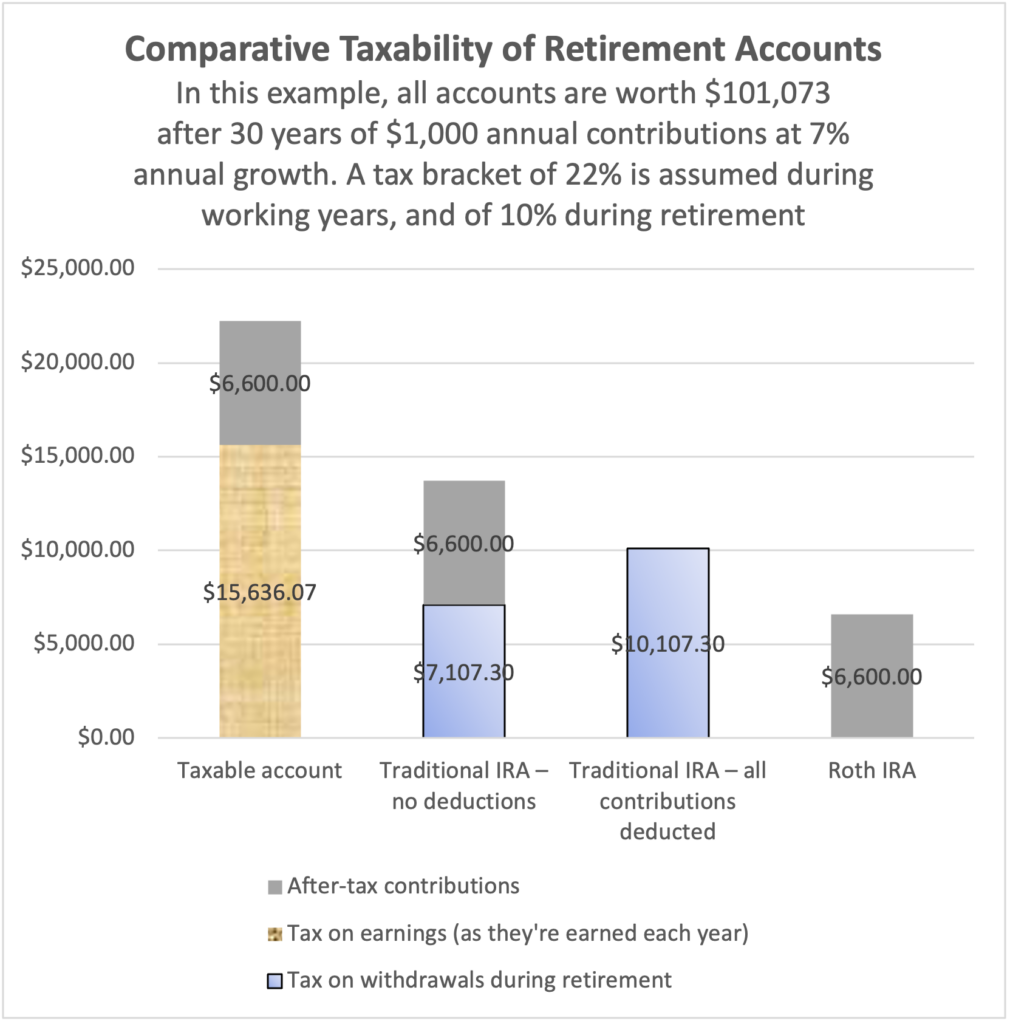
Let’s consider a conservative example of someone who contributes $1,000 a year for 30 years at a growth rate of 7% a year. This is a conservative assumption since between 1995-2025 the S&P 500 has averaged better than 10% a year. But even at 7%, you would more than triple your money with an ending balance of $101,073 after 30 years of contributing $1,000 per year.

Let’s assume a taxpayer who is in the 22% tax bracket while working and in the 10% tax bracket during retirement.

If this were a taxable account, your contributions would be made from after-tax money, corresponding to $6,600 ($1000 x 30 x 22%) in income tax paid on 30 years of contributions. In addition to this, tax would be due on the earnings that grew in the account each year. Taxed at your marginal rate, this would total $15,636.07 (($101,073 – $30,000) x 22%) paid as it is earned. In reality, tax on earnings might be slightly less because some of it would likely be eligible for the lower rate on qualified dividends and long-term capital gains.

If the account were a traditional IRA with no deductions taken, you would have paid the same $6,600 on contributions as with the taxable account. The earnings, however, would be taxed at the lower rate as they’re withdrawn during retirement: a total of $7,107.30 (($101,073 – $30,000) x 10%).

If the account were a traditional IRA with all possible deductions, the only tax paid would be on withdrawals during retirement: a total of $10,107.30 ($101,073 x 10%).

If this were a Roth IRA, you would pay nothing on earnings and nothing at withdrawal. The only tax involved would be that same $6,600 you paid on income that you used to make the contributions over 30 years.

Here is a graphic view:

Of course, the numbers here are arbitrary, but the dynamics should be clear. As your time horizon is longer and your annual contributions and percent growth are larger, these differences become more pronounced.

If you expect to retire into poverty to the extent that you will never be subject to tax on withdrawals from your IRA, then by all means open a traditional IRA so you can at least deduct some of your contributions. But if you expect to have taxable income in retirement, and especially if you can begin saving early in life, you are almost certainly better off with a Roth. And you are almost certainly better off contributing the maximum allowed to your Roth each year.

In the spirit of manifest destiny and the Homestead Act of 1862, we might even say: “Go Roth, young man, and grow up with your tax-free earnings!”

When considering the annual limit on contributions to IRAs, note that contributions to Roth IRAs are included for this purpose. You may contribute to any number of traditional and Roth IRA accounts in the same year, but total contributions may not exceed the annual limit, which is $7,000 in 2025 for taxpayers under 50.

Another advantage of the Roth is that because there is no tax after you retire, there is no required minimum distribution either.

The Roth Legacy

Not everyone will be won over by the mathematical arguments that favor the Roth IRA over the tax-deferred “traditional” IRA. But consider that since the introduction of Roth in 1997, its influence has only been growing, while “traditional” becomes more of a circumscribed concept.

Newer types of tax-advantaged savings vehicles such as 529 college plans, first introduced in the Economic Growth and Tax Relief Reconciliation Act of 2001 (EGTRRA), work according to the Roth model. Contributions are not deductible, but earnings are never taxed if the money is used for qualified purposes. This is essentially a Roth-type plan. The only difference is that the qualified purpose of a 529 account is education, not retirement. The only reason no one talks about a “Roth 529” is that there is no such thing as non-Roth 529.

Even Qualified plans available through employers are showing up in Roth variations. Many companies now offer a Roth 401(k). As you can imagine, this is just like a “traditional” 401(k) except that the contribution is not excluded from taxable income and the earnings are tax-free if not withdrawn before retirement.

Even state-employers are getting in on the Roth model and offering Roth-type Qualified plans for state employees. The general term for these is “Roth-designated accounts”. A “Roth-designated” portion of an account will work just like the non-Roth part except that the contributions are not excluded from taxable income and the earnings are tax-free if used for qualified purposes.

Rollovers and conversions between all these types of accounts should follow the same general principles as for more well-established types of account. There is as of yet not a lot of documentation on every possible type of rollover or conversion.

In the next post in this series, we will review conversions from traditional IRAs to Roth IRAs (“Roth conversions”).

History of the Retirement Plan, Part II

Preface: “As in all successful ventures, the foundation of a good retirement is planning.” – Earl Nightingale

History of the Retirement Plan, Part II

The following is the second in a series of blog posts on the subject of retirement plans. The first installment, which can be found here:

    • Briefly reviewed the history of government-defined retirement models in the United States,
    • Introduced the tax-deferred model, and
    • Explained the difference between Qualified plans and Individual Retirement Accounts (IRAs).

This second installment will discuss:

    • Limits to deductibility of retirement contributions, and
    • Tax treatment of non-deductible contributions.

Future posts in this series will address:

    • The Roth model.

Non-Deductible Contributions to IRAs

Within a decade after the creation of the Individual Retirement Account (IRA) in 1974, the government began having second thoughts about letting individuals deduct the entirety of their IRA contributions from taxable income. They were especially concerned with higher-income employees who already had generous qualified retirement plans through their jobs. If you or your spouse could already exclude five figures worth of your wages from your taxable income, why should you also be allowed to deduct your IRA contributions?

The Tax Reform Act of 1986 introduced income limits on deductibility for individuals who were covered by Qualified plans at work and for their spouses, even if the spouse is not covered by a qualified plan.

The dollar amount limits set forth in 1986 are increased every year or so for inflation, but the basic three-tiered system introduced in 1986 is still with us. Here are the 2025 income limits for married filers:

MFJ, neither covered by Qualified plan MFJ, covered by Qualified plan MFJ, not covered by Qualified plan but spouse is
All of IRA contribution is deductible with no income limit. All of IRA contribution is deductible if combined AGI is less than $126,000 All of IRA contribution is deductible if combined AGI is less than $236,000.
None of IRA contribution is deductible if combined AGI is more than $146,000. None of IRA contribution is deductible if combined AGI is more than $246,000.

And for single filers:

Single, not covered by Qualified plan Single, covered by Qualified plan
All of IRA contribution is deductible with no income limit. All of IRA contribution is deductible if combined AGI is less than $79,000
None of IRA contribution is deductible if combined AGI is more than $89,000.

Under this system, not all money in all IRAs is tax-deferred. Individuals who are limited from deducting their contributions in whole or in part must pay tax on those amounts in the current year. Therefore, some of the money in their IRAs going forward is after-tax money.

This is bad because it means you have to pay tax on it this year. However, it is also beneficial, as you will never have to pay any tax on it again. And the earnings from the after-tax portion of the contribution will have the same tax-deferred status as the earnings from the pre-tax portion.

An IRA is Worth More Than Just Its Deduction

People will sometimes say that they don’t want to contribute anything to an IRA that they cannot deduct on their current year tax return. But consider that if you don’t take the deduction on a contribution now, you will not have to pay tax on it when it is withdrawn. You are in effect taking the deduction after you retire instead of taking it now. Of course, if you expect to be in a lower tax bracket in retirement, the deduction now is worth more than it will be then. But if you cannot take the deduction now, you can still get it later. It is not lost forever. And by contributing the maximum today, you still get the maximum amount of earnings growing tax-deferred.

Example: You contribute $1,000 to your IRA. Of this, you are only able to deduct $500. Over the years, your IRA grows in value to $4,000. After reaching retirement age, you withdraw the $4,000. The $500 you could not deduct is withdrawn tax-free, since tax has already been paid on it. The remaining $3,500 is taxed as ordinary income upon withdrawal.

If you are in a lower tax bracket when you retire, you might feel bad that you had to pay tax on $500 of the contribution back in the day when you were in a higher tax bracket. However, the $3,000 of earnings is still all taxed at the lower rate, even though the non-deducted portion of the contribution generated half of it.

Imagine you had not contributed that $500 because you couldn’t deduct it, but had invested it instead in a taxable brokerage account. Then the $1,500 of earnings it generated would be taxed when you earned it, at the rates you were subject to at the time.

Here is a schematic view of the differences:

IRA – deducted on contribution IRA – not deducted Taxable account
Contributions Taxed on withdrawal

(lower rate)

Taxed on contribution

(higher rate)

Taxed on contribution

(higher rate)

Earnings Taxed on withdrawal

(lower rate)

Taxed on withdrawal (lower rate) Taxed as earned

(higher rate)

Unless your time remaining to retirement is very short, the value of your IRA during retirement resulting from this year’s contribution will likely be more than twice the amount of the contribution. So unless you have reason to think you will not be in a lower tax bracket after you retire, the value of contributing to an IRA is likely greater than the value of your current year deduction. So it is likely still worth contributing the maximum each year, even if you can’t deduct all of it.

Tax Treatment of Withdrawals from Mixed-Status IRAs

If you ever make a contribution to your IRA that is not completely deductible, you are supposed to file Form 8606 every year with your tax return to track the after-tax amount in your IRA from year to year. If you do not track the after-tax portion throughout the life of the IRA, you may have to pay tax on the entirety of your withdrawals.

When you attain retirement age and make a withdrawal, you are supposed to prorate the taxable amount of the withdrawal. The calculation is likewise done on Form 8606.

Example: You contribute $1,000 to your IRA. Of this, you are only able to deduct $500. Over the years, your IRA grows in value to $4,000. After reaching retirement age, you withdraw the $4,000. You have dutifully filed Form 8606 each year of your working life so you can prove that exactly $500 has an after-tax status. The $500 you could not deduct is withdrawn tax-free. The remaining $3,500 is taxed as ordinary income upon withdrawal.

But wait! Let’s say you don’t want to withdraw the entire $4,000. Let’s say you only want to withdraw $1,000. You might think: “I will withdraw the $500 that is after-tax and $500 of the pre-tax money. That way, I will only have to pay tax on half of my withdrawal.”

Unfortunately, that is not how the IRS will see things. Any amount you withdraw from a mixed-status IRA needs to be prorated based on the ratio of total after-tax holdings to the total IRA value. Therefore, only 12.5% ($500/$4,000) (which is to say $125) of your $1,000 withdrawal is tax-free. The other $875 is taxable. You then reduce the after-tax amount of your IRA by the $125 you withdrew and carry the result to next year’s Form 8606

The taxable ratio is computed based on the total pre-tax holdings in all your IRA accounts over the total value of all your IRA accounts. This includes all SEP-IRA and SIMPLE-IRA accounts, but not qualified plans. So you cannot manipulate the taxable proportion of your withdrawals by keeping separate IRA accounts and making withdrawals from the one with the desired taxable proportion.

There are, however, several ways to increase the after-tax proportion of an IRA. One of these is the Qualified Charitable Distribution (QCD).

Strategy #1 for Increasing the After-Tax Proportion of an IRA: Introducing the QCD

The QCD is available to owners of IRAs who are at least 70 years old. They must be made to tax-deductible charitable organizations, and the transfer must be made directly from the IRA. You cannot just write a check to your favorite charity and declare it a QCD. A properly made QCD is entirely pre-tax and cannot be used as an itemized deduction. It is excluded income, which is why none of it can have an after-tax status.

A QCD can be used to fulfill a Required Minimum distribution.

Example: You have $4,000 in your IRA and you have attained retirement age. You have dutifully filed Form 8606 each year of your working life so you can prove that exactly $500 has an after-tax status. The company that administers your IRA informs you that in the current year, you must make a required minimum distribution of $500 to avoid penalties.

You direct your IRA administrator to send a QCD of $500 to your favorite charity. This distribution will not be taxable to you. Furthermore, it reduces the pre-tax part of your IRA by $500 without reducing the after-tax part. After this QCD is made, you are left with a balance of $3,500 in your IRA, $500 of which remains after tax, just as before. You have effectively increased the after-tax proportion of your IRA.

Strategy #2 for Increasing the After-Tax Proportion of an IRA: Rollover to a Qualified Plan

Another way to increase the after-tax portion of your IRA is to make a rollover to a qualified plan. A rollover is simply a transfer of funds from one account to another account with a similar tax status. Because a Qualified plan is pre-tax, all rollover amounts to a Qualified plan must also be pre-tax.

A rollover is not a distribution and cannot be used to fulfill a Required Minimum distribution.

Example: You have $4,000 in your IRA and you have attained retirement age. You have dutifully filed Form 8606 each year of your working life so you can prove that exactly $500 has an after-tax status. The company that administers your IRA informs you that in the current year, you must make a required minimum distribution of $500 to avoid penalties.

You decide that first you will roll over some of the IRA into a Qualified plan you have from a job. The rollover to the Qualified plan can only be from the pre-tax part of the IRA, so you will not be able to roll over more than $3,500. Any amount you do roll over will increase to proportion of the IRA that is after-tax.

If you roll over the entire $3,500, only the $500 of after-tax money will remain in the IRA. This can then be withdrawn to fulfill the RMD, and it is now 100% tax-free. The $3,500 that you rolled over retains its pre-tax status within the Qualified plan, so the rollover is itself a tax-free event.

If you are aware of any alternative methods to increase the after-tax portion of an IRA beyond a QCD or a rollover to a qualified plan, please contact me at bgelbart@saudercpa.com and let me know.